
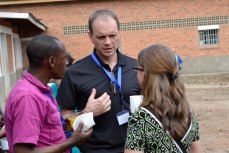
Photo credit: Heather Evans
Let me introduce myself. My name is Phil Monroe and I am a Christian Psychologist. From 2000 to 2017 I was the Director of the MA Counseling and related programs in the Graduate School of Counseling at Missio Seminary (formerly Biblical Seminary). One of my projects was to create the Global Trauma Recovery Institute, to train those interested in facilitating trauma recovery in cultures outside their own. Check out my page “Global Trauma Recovery Institute” introducing you to my most recent adventures in teaching and training online and around the world. Currently, I am the Taylor Visiting Professor at Missio.
From 2017 to the present I spend a chunk of my time representing the Trauma Healing Institute at American Bible Society. I have held multiple roles there, director of training and mentoring, director of materials development and director of THI. It was an honor to represent them as a trainer in 19 countries and to help contextualize core materials for use by church leaders around the world.
My clinical experience now spans 32 years and diverse settings (outpatient private practice, church-based, residential, jail, and community mental health). Currently, I am the owner of Langberg, Monroe & Associates and partner with Dr. Diane Langberg to care for our clients.
If you would like to know more about what I think about Christian psychology and professional counseling, start with this post: Why study professional counseling at a seminary?
I welcome comments that encourage or challenge me to think more. Please remember the fruits of the spirit as you do so. In order to avoid the problem of spam comments, I moderate all first-time commenters.

 Musings on Faith and Psychology
What was your dissertation on?
You really want the title? The Development of the Discharge Readiness Checklist–Revised: A functional assessment instrument for children in residential and foster care treatment. I took the advice of several professors to do a contained dissertation rather than write a tome which I might have rather done but would have never finished in the time I could do a statistical dissertation.
My name is Erin and I am a Graduate student in the counseling program at Baptist Bible College and I am doing a paper and presentation on you. I was wondering if you could help me out by pointing me to some resouces or by answering some questions for me. I would like to know about your biographical background and the history that led you to where you are today. I have read some of your articles and I believe that they will help me in understanding your views on certain areas like the Holy Spirit’s work and involement in the counseling session, the role of Scripture, and any other apporaches you use. I was wondering if i could have a complete list of your writings and articles. Thank you so much for your time.
Hello Phil
i am a christian and a adult survivor of childhood abuse. As i have been struggling with depression on and off for many years and believe in scripture and prayer i have decided to attend a psycho educational course. In your experience would this course benefit me or am i not trusting Jesus to be my healer.
Kind Regards
Maxine
Dear Maxine, Such a course might very well be helpful. It all depends on the quality of the teacher and the content. But, to your question, would taking a course be not trusting Jesus? Of course it isn’t distrustful to learn about your body and about how trauma can harm. Any more than it would be harmful to take a class on how to understand the body that God has given you. If healing takes place, whether in an operating room, a counseling room, a psychiatrist’s office, or in your own home, then we Christians know that Jesus is part of it. So, go to the class and learn what you can.
hey mate, great website,
I identify alot with this stuff and seen a counsellor the other day cause she is a friends mum and discovered alot of this stuff is identified as normal conditions, even having labels!…’anxiety’ etc didnt even know as im 19 and would appear like im goin well.
Been a Christian my whole life and Gods brought me through alot of stuff, I was wondering:
I have had this terrible habit since i was round 10 where i cant stand small noises, movements, anything that is repetitive in sound or movement-stuff like people biting there fingers or anything that resembles it, people eating with there mouth open, spoons clanging on bowls, people sipping tea repetitively, clicking noises from computers or computer games, people banging there feet on trains.
Not sure but they sound like normal annoying things but i seriously go insane whenever trapped in a situation or environment especially if i cant take in own hands and leave.
I was wondering if there is any resource or info on the net, I dont really know how to approach it!!
Thankyou so much
dan
Daniel,
Thanks for your inquiry. Your experience sounds like part supersensitivity (some people are just more sensitive to noises, touch, etc.) and part anxiety (the need to escape). Not sure there is much to do about the sensitivity part but learning distracting skills would be helpful. Start with small, only slightly noxious experiences, and with the help of a counselor practice distraction techniques. Sort of like when you get a paper cut you can either fixate on it and really feel the throb or distract and have it fade to the background. Hope that helps.
Hi Phil,
I recently came across your site and this inqiery on supersensitivity and anxiety was of interest to me. It is something that has been a problem for me since childhood, especially as it relates to my mother (she has many minor idiosincracies thay anoey me such as slurping, eating with mouth open, clanging of cutlery and other habits). I come from a family that experienced seperation when I was 8 yrs. old, but the home had much stife for 4 years previous to seperation. My father berated my mother in front of us children for such acts and compounding this shaping of attitude towards my mother by my father was the fact that my mother was left to discipline us and therefore assumed the role of meany in my young mind. To this day I am strongly irritated by these annoeyances, though I know that they are really trivial and have no bearing on who my mother really is. She is a Godly woman who has been to me and other an example of God’s unconditional love. I wonder if the factors in my “condition” are more do to environmental conditioning and not so much something nerological.
Thank you, Bill
There is a clinic in Fort Collins, Co that has developed a filter for people who have auditory processing disorder. They test to see if that’s the problem. The filter has been effective for my son and three of my grandchildren, who reported symptoms like Daniel’s. Search Auditory Processing Disorder, Fort Collins Colorado.
What is your take on those who would argue that “christian counseling” is guilty of “psychoheresy”?
I am a mental health nurse so I am interested in the interface between psychology/psychiatry/mental illness and christianity. with many of my clients i see the results of both their organic illness and their experiences in producing the issues thay struggle with on a day to day basis. I also see from my Christian faith the impact of sin and spiritual side to their condition.
Grahame,
There are some Christian counselors who practice what might be called naive Christian counseling–where they imbibe too much from a secular (materialist) view of persons without even knwoing it. Unfortunately, those who are aware of this problem tend to be attack dogs who throw the baby out with the bathwater. Just because an unbeliever describes a feature of humanity doesn’t mean that feature is completely without warrant.
It is hard to divide the organic/spiritual aspects of mental illness. And yet we agree they are there. Which comes first? We do not know. And yet, we ought to treat both.
In your professional world, do you see opportunities to treat the spiritual as well as the organic? In the US that would be considered difficult.
Phil, what do you mean by “In the US that would be considered difficult?”
hello! i luv your site, and I’m glad to meet another Christian blogger! stop by mine @ http://scripture4u.wordpress.com
Keep in the Faith!!
-neogotchi
Thanks for your interesting and relevant thoughts and observations.
I look forward to further dialogue.
Kerry D.
Hi Dr. Monroe, I was referred to your website by Dr. Jeff Black, who was my program chair at Philadelphia Biblical University. I plan to check your musings every so often, and it looks from what I’ve seen so far that I’ll benefit from them! I’m working with troubled children and youth in residential treatment in NW Ohio, while I pursue LPC licensure, but I hope to establish some biblical counseling practice on the side. Jeff referred me here when I mentioned to him that it would be nice if more established professionals would reveal to us “novices” what you guys are reading, or “what’s on your nightstand” as your site puts it. That’s invaluable to me, and it keeps my reading list fresh! Looking forward to checking in more often! Scott.
Where did you come up with that silly “Musings” name for the blog?
Phil,
Can you recommend a good read about integrating Christian Counseling with Addiction Counseling, particularly in my areas of strength which are in CBT and RT. I
Your musings are brilliant and inspirational!
Thanks, Jon
Have you ever read Addiction and Grace, by Gerald May? He approaches addiction as both a bio-chemical trap and a universal spiritual problem of over-attachment/idolatry, with a Judeo Christian perspective that also acknowledges wisdom from other traditions. While he does not discuss technique or intervention, his perspective helps build empathy and understanding between those who are (merely) addicted to substances and those of us with more powerful addictions/attachment to success, reputation, materials, approval, pride, control, knowledge, etc. This has helped me in my clinical work with dually diagnosed adults.
Bob, yes. I think it is a good book. Older but a classic.
I really enjoy your blog. I’m a Christian counselor and have a blog as well. It is good to read other Christian bloggers.
I think Leslie’s work on sexual abuse is great. I’d love to sit in on your supervision sessions… the discussions must be great!
Thanks Chris. We do have fun in supervision. Its the best part of my day.
Jon, I don’t have a great idea for you. You might read Ed Welch’s book on Addiction (a banquet in the grave) but it isn’t much of a fine detail book. But it does give a good overview of the fight we must wage against addictive thinking and belief patterns.
I’m curious to know what your opinion is of the growth of lay counseling. My town has a counseling center which they fancy is based on CCEF. The challenge I see is that we now have a lot of “counselors” who’ve gone through lay counseling courses and are giving alot of bad advice to people in need.
I took the introductory course where one of my classmates was a women who was in a physicall abusive marriage. She was being told by a “counselor” that she had no biblical basis to leave the marriage. This woman had visible bruises!
Most of the classes wrapped up by an exhortation for students to write down bible verses and put them in your wallet or purse for use when troubles arise.
I know this is not what you do, but I’m alarmed that our large PCA church is referring people to this place for some pretty severe situations. The counselors don’t have professional counseling credentials and most of them have a very immature understanding of biblical counseling principles.
Do you see this as a problem in many communities?
Jim,
The idea behind lay counseling is that wise and mature believers, with gifts of patience and gentleness might be able to walk with those who are struggling in life. However, if a lay ministry is not careful, they attract those who want to merely exhort others to feel good about themselves.
Your classmate was obviously given terrible advice–as if the only solutions are stay or leave. The Scriptures are clear about the need to protect the vulnerable. While I might not suggest immediate divorce, I would highly suggest the need for protection and ministry to both. A severe mercy to the man and protection for the wife.
Bible verses are helpful in times of trouble. Wisdom is knowing what God is saying or wants you to do in a particular area.
By the way, CCEF would not abide by counselors doing either of these things that you mentioned.
I actually see less churches doing the lay counseling bit these days. I see more churches willing to use well-trained counselors. These counselors may not be licensed but they do have good wisdom to know what they can and cannot do.
Phil, great website. I enjoyed checking it out some this morning. Peace, Kelly
Kelly, thanks for dropping by. Enjoyed your family pics on your site. Can’t believe Evan is 6. Miss having you around.
Phil
Hello Phil,
I found your site while doing a search for resources that could help me study up on basic psychology. I would like to pass my college’s CLEP test without actually having to take the Psychology 101 course. Christian resources would be great, but anything that you think is a good, well-rounded intro would be fine.Do you have any recommendations?
Thanks,
Phoebe
Phoebe,
You might try David Myer’s text (www.davidmyers.org) as it is classic in many a university. He is a Christian and while I wouldn’t subscribe to his version of Christian Psychology (see the IVP book, Psychology & Christianity: 4 views for some other options)
Phil
ooooo I *LOVE* your terminology of ‘severe’ mercy!!! Never ever heard it before. But I’m willing to bet I’ve walked it with my husband!
Spent 18 years in an abusive marriage with a man who ‘thought’ he was a christian, but had never accepted Christ, but knew the scriptures inside and out. Lived and died by the ‘rules’ of the law. (literally) Bible thumping, King James, hard line, rule, you’ll obey me or suffer … “Don’t give me that love junk” (literally said that)
until he turned 50 … and decided he didn’t like himself ..and then told God
“I give up, I surrender, God I need you in my life, I need your son! Jesus, save me from myself”
and overnight … changed to the man God created him to be! Our marriage was immediately redeemed to what it was intended to what it was created to be as well.
Do I believe in miracles …oh yea.
Should I have stayed … hind sight is 20/20 … I wouldn’t recommend someone in my place to stay, I’m not sure why I did. Like many in my situation, I felt stuck, helpless, although, I was working to get out safely …. and praying for God to make it so I didn’t have to before I did have to.
All while I followed the principals that Peter and Paul laid out …being the witness that just might bring him to the Lord … not subserviant ..but Christlike.
it wasn’t easy. By any stretch of the imagination.
But I do think it was probably what you mean by ‘severe’ mercy.
Hey Phil,
I recently picked up a book by Eric Johnson titled “Foundations for Soul Care: A Christian Psychology Proposal” and I know it is a long book (622 pages of actual text) but I am curious if you might be thinking of reviewing it and posting your thoughts?
As someone just finishing an MSW and trying to help people while grow with Christ, I appreciate the insights you share. Don’t stop.
Tempting but Eric’s book is THICK, both in pages and content. Not sure I’m up to it, really. But thanks for the encouragement.
Hi Phil,
Thank you for this site!
Hi Ryan,
Johnson’s book sounds interesting; I don’t know that I have time to read it right now either,
but I commend you for wanting to grapple with the important issue of learning how life in Christ can inform and form our relationships with ourselves and each other. Perhaps after you read it you would post your thoughts about the book here.
Also, although I dont’ know a great deal about him, you might be interested in reading something by Don Browning, professor emeritus from the Divinity School, University of Chicago. You can find info about him on the U of C website.
I read one of his books many, many years ago and it opened my eyes to the “theories of obligation” that are embedded in psychological theories and methodology. In other words, the “answers” to questions such as what is the good life and what should be our relationships with each other. The the answers to these questions shape our lives and interactions and thus need informed, clearly articulated and understood answers.
I was saddened by my own MSW education in that neither professors nor most students were interested in thinking about how they should then approach their choice of therapeutic model for their clients.
Can you recommend a Christian Psychologist in the Central Maine area? Thank you!
I don’t know of any, sorry.
Hello. I was wondering about the type of schooling you’ve had. I’m an undergraduate student, getting my degree in counseling psychology, and I hope to one day be a Christian Psychologist. So, my question is should I go through a PhD program and then go to seminary or go straight to seminary to get my PhD? Thanks so much!
Jenna, I have a BA in theology, MA in Religion (concentration in counseling), MA and PsyD in psychology. Not your usual path to psychology. But I wouldn’t do it differently.
I found seminary to be very helpful to do before I got my doctorate. There are some seminaries you can get a doctorate as well as theological training (Fuller Theological Seminary) but most do not.
Phil, I’m a youth pastor in MN, but grew up in Doylestown and graduated from PBU and DTS. Also worked at Calvary Church of Souderton for a couple years, so we might have a couple mutual friends.
I’d really love to run an idea by you, but I can’t find your contact info anywhere, so if you could email me, that would be great. Thanks, Phil!
thanks for the compliment on the photos of my kids. it’s so easy taking pictures of them because they are just so beautiful and charming all the time. i enjoy your site – keep posting!
Phil,
Your post today calls to mind three verses from Scripture (NIV) that have relevance to all people-helping. Proverbs 19:18 refers to what I call the enabler’s dilemma: “Discipline your son, for in that there is hope; do not be a willing party to his death.” In our efforts to help others, we must not fail to function correctively as is proper, for in doing so we leave people in their self-destructive state. Will missionaries wisely address (as the situation permits, from God’s perspective) whatever relevant self-destructive patterns are inherent in the host culture?
Proverbs 19:19 says, “A hot-tempered man must pay the penalty; if you rescue him, you will have to do it again.” This addresses the rescuer’s dilemma: how can we help others to help themselves, rather than to foster their dependence on us? It is better to teach people to fish than to keep providing fish for them–a concept every missionary should model.
Finally, Romans 15: 2 teaches, “Each of us should please his neighbor for his good, to build him up.” Every missionary (or people-helper) needs to ask herself: “Are my efforts contributing to the edification of those I am trying to help? That is, are they becoming better, healthier, godlier people in some way? If not, what we are doing may bring pleasure, but it is not bringing progress.
Colossians 3:17 tells us to do everything in Jesus’ name. That mandate is not a command to use those particular words; it is an instruction about how to live life. To live and minister in Jesus’ name means to function in his character and truth with his power and authority for his reputation and purposes–an excellent vision for any people-helper, including missionaries.
Rick
Hi Phil.
There are many things I’d like to say, but I’ll attempt to be brief, starting with ‘Hello! Thank you for this blog!’
I’m new to blogging, but really enjoying reading other Christian authors. I’m a doctoral student in practical theology, but my background is in music and for years I have been wanting to study the psychology of music and maybe even do counselling work as a honest layman. God has kind of now made it clear that I will STILL go towards music psych in the future – but that I needed to spend some serious time studying the things of God before I do all of that. So when you say that you found seminary to be very helpful before doing your doctorate – I can now really identify with that!
I look forward to becoming acquainted with your posts, and also to one day joining you in this very important field of psychology as a fellow Christian believer one day.
Blessings,
Alex.
Hi Phil,
I’m a Licensed Clinical Social Worker and Therapist with 9 years of practice. I have a small private practice on 7500 Germantown ave. Philadelphia. I’m certified in Cognitive therapy, in which three aspects of cognition are emphasized: automatic thoughts, schemas, and cognitive distortions. I’m wondering what your thoughts might be on using this model as a tool in biblical counseling.
Thanks so much.
ps. Love your blog
Welcome Tim. Glad to hear from you and that you are a neighbor. Did you get certified with the Beck folks? I think many CT tools were well in reclaiming the mind. I do think that constructive CT deals a bit better with emotions since our thinking/feeling/behaving isn’t as linear as some of CT proponents would suggest.
Stop by anytime.
Phil
Tim, you know we used to go to the same church? Or maybe we still do: NLG.
Hey Phil,
I’ve been following your blog for months, and find myself in the position now where I am a Christ-follower who is also applying to a doctoral program. Honesty is, I am hoping for some advise.
I am walking towards this intimidating thing, pursuing this desire in my heart for…. more education… being further prepared and equipped to walk with people in the depths of their real problems, and to equip aspiring counselors to do the same. I feel like Abraham walking towards this promise but having no idea what it will require of me or how it will actually be fulfilled. Also, being the Larry Crabb fan that I am, I recently reread Shattered Dreams and am sure that the Lord could be using this to allow me to further know Himself.
Having said that, I am pursuing only one program, the one closest in proximity to me, because I don’t believe I can honor God in my pursuits while simultaneously never seeing my husband and having my priorities elsewhere. I can’t understand pursuing a deeper understanding of “health” while living in an unhealthy manner.
Do you have any advise? encouragement? words of wisdom? I would sincerely appreciate it.
Thanks, -Carmella
Carmella,
Thanks for dropping by and introducing yourself. You sound wise. You are right it would be no good to gain knowledge at the expense of your marriage. Be sure to include him in your learning. As you grow, make sure he participates in your learning.
If the program you are pursuing isn’t a Christian program then maybe look at the bibliographies listed at http://www.christianpsych.org for enrichment.
Phil
Hi! I am hoping that you might be able to help me. My husband and I are looking at adopting a little boy. I would like to speak with a Psychologist about his past and behavior issues before we do. I would like for the Psychologist to be a Christian so we will share the same view point, but I do not know how to find one in my area. Do you know how I could find one?
Thank you and God Bless, Amanda
Phil,
It’s very nice to meet you. 🙂 I regularly search my name to find out what I’m being attached to online. I found your blog post about a short piece I wrote a while back:
https://wisecounsel.wordpress.com/2008/10/22/defining-multiculturalism/
I’m intrigued not only that you found the piece but also that you found the final question/call to action interesting enough to post.
I’ll be spending a little time checking out your blog and hope to be back soon. By the way, I am finishing up a program at Alliance Theological Seminary and my husband received an M.Div. from Fuller Theological Seminary. We have lively conversations about the affect Christianity should (does?) have on race relations in the States.
Thank you for providing an intellectually stimulating Christian space.
Pingback: Introducing A New Blog And An Article On Forgiveness « More Than Coping
Phil,
Thank you for putting yourself out here. I will spend some time reviewing your blog and likely be back, but finding your blog is already an answer to prayer, so I’m resolved to ask:
What would/do you say to christians who are completely against psychology and think that the only way a christian should offer counsel is through God’s word?
I have family members who have been diagnosed with various mental illnesses and have basically used the label as an excuse to give up on life and responsibility as well as their God-given potential. I feel/sense that in order for me to be able to counsel such people (in a formal setting) and be able to point them towards their identity in Christ instead of the labels, that I first need to fully understand the diagnosis and everything that goes with it, therefore I feel that God is leading me to go back to school for a BA in psychology.
My thinking was that I can go through and get my BA, (daily examining the content for His truth) and in the end, use the ‘scientific/medical’ aspects in order to make behaviour modification while through prayer and His word, counseling people to look for truth, identity, restoration, redemption and life change in Him.
But after having several christians whom I respect and go to for counsel/advice express valid concerns I feel stuck and am unsure whether I am headed in the right direction.
Any advice or wisdom would be sooo appreciated. 🙂 Thanks. Hannah
Hi: I would like to put reciprocal links between your site and mine (www.schizophreniasupportnetwork.com) …look forward to hearing from you.
Thanks, Blair
i NEVER surf the web to distract from stress (i have other ways), but having found you, i just might start. really enjoyed surfing you!
thanks…i’ll be back,
Carolyn
I’ve been following your blog for a while, and I am only just now having time to write in and tell you how much I’ve appreciated your posts. I’m a LMFT in California and a member of AACC. Igot my MDiv in Counseling from New Orleans Baptist Theological. I’ve just started my own blog at http://mindhealingfiction.blogspot.com which will hopefully chronicle my journey to getting published, and I follow your posts from there.
Anyway…just wanted to say hello and tell you how much I enjoy reading your blog. Blessings!
Jeannie
Phil, Great web site, blog, and great model of counseling. Your educational path and your blending of Christian psychology, biblical counseling, the SCP, and the CCEF are, indeed, rare. My similar path of BA in Bible/Pastoral Ministry, M.Div./Th.M. at Grace, MA in Biblical Counseling under Crabb/Allender, and Ph.D. in Counselor Ed at Kent State followed a similar “maze.” The amazing thing about the maze is God–He was/is in it all the time.
We also share a similar position of appreciation for and development of various approaches. As director of the AACC’s Biblical Counseling and Spiritual Formation Network, I consider my “model” part biblical counseling, part biblical psychologist, and part spiritual formation. Like you, I have great affinity with the SCP and the CCEF.
Glad we can connect in ministry to souls in need of Christ’s sustaining, healing, reconciling, and guiding.
Bob
I liked you up until the Red Sox fan… (I’m originally from NY.) 🙂
I just wnat to know when your book is coming out and what will be the title? Looking forward to it!
I think of myself as a Christian who happens to be a psychologist. I know the way I practice is influenced by my spirituality. I know that some people seek me out because they know of my faith commitment. I will discuss issues of faith and spirituality if my client brings that up. Although I have considered doing so, I do not feel comfortable calling myself a Christian psychologist. Seems more of a marketing ploy on the one hand and judgmental on the other hand. Neither would I call myself an Irish psychologist or American psychologist or Catholic psychologist or black or white psychologist.
Dr. H. Welcome to my musings. Maybe some use it as a marketing tool, but I would regard the title “Christian psychologist” as part of my informed consent. Clients have a right to know how I approach problems and the title right away conveys something. Obviously, not enough because anyone can use the title to mean anything. But, that is also true with just about any title. For me, at least it is a start of the conversation.
I see that. If your preference it so approach all issues from a biblical reference, it would be important to inform all potential clients – those who profess Christ and those who do not.
I have found that many people whose world is organized by their understanding of Christ and the Christian community to which they belong are apprehensive about psychologists. There is often an assumption that psychologists are hostile to Christianity. I have been asked on occassion to provide pre-admission assessments for young people pursuing seminary training leading to ministry. They have been particularly sensitive to knowing my biases before beginning the process. Some have related troublesome stories they have heard from their peers.
I’ve just discovered this site and blog. Looking forward to poking around more. Thank you for your thoughtful comments about the integration of your practice and your Christian commitment. Please feel no pressure to respond, but if you’re interested, I’ve tried to bring Christian wisdom to a topic of interest to many psychologists: self-deception. You can find my attempt here:
Many blessings and keep up the good work!
Gregg
Hi Dr Phil- just thought it would be fun to start off calling you that. I just found your blog and really have enjoyed reading through your archives. I have a partial M Div completed in pastoral counseling from a small seminary in Illinois. I an curious as to your impression of the works of David Seamands and Dan Allender?? Also, i am a Mets fan, sorry about 86. Not really 😀
Robert, thanks for dropping by. Can’t really give you a decent answer here to your question. I prefer to consider an author’s observations and assumptions behind them. Sometimes I agree with their observations but not their assumptions. Other times I agree with their assumptions but do not like their form of intervention. I didn’t much like “healing for damaged emotions” when I read it almost 20 years ago. I’d have to revisit it to have an opinion now. Dan has some good work out there with Tremper Longman. I’m less enamored with his wounded heart book.
Can’t blame the mets for ’86…but you met fans are getting your due these last few years, huh? They look more like the collapsing Sox of years goneby.
Phil- thank you for your response. I like your take on investigating both observations and assumptions. On a forum I frequent, we have been pondering the interaction between thoughts/feelings/faith. Do you have some initial insights on how they intertwine and do you think fear and faith can coexist to some degree at the sametime??
Yes sadly we met fans have suffered last few years. Does redsox nation miss manny or glad hes gone???
Hello! It is nice to find your blog. I am currently employed as an elementary school teacher, and have been working in the educational field for 11 years. I would like to pursue a different career path. I have been a Christian for 20 years, and I have always been especially interested in Christian psychology. I feel as though the Lord has given me gifts of insight, wisdom, and discernment in counseling. I am passionate about psychology. Currently, I can not decide whether to pursue further education to work within the public school system as an educational psychologist or to pursue a career in Christian psych.
I have experience in the ins and outs of education. I also have a heart for abused women, having been one, single women, and children. The human mind fascinates me!
I want to pursue truth. I am afraid that if I go the educational psych route, I may be missing out on learning about and conveying God’s truth. Yet, I have so much experience in education.
Any thoughts or direction for me?
One option would be to pursue the ed psych route while also taking courses from a reputable Christian institution. You might take courses from my institution (assuming you live near Philly), CCEF (www.ccef.org) has on-line non grad credit courses that are a good foundation for thinking Christianly about change. Or, you could educate yourself via diligent reading (books by Diane Langberg, Ed Welch, Eric Johnson, Mike Emlet, David Powlison).
In ed psych, would you be focusing on children (school psychology? School Counseling). There are a lot of career options you need to explore as the programs for these are highly specialized and not easily transferrable to other sorts of careers (e.g., private adult counseling). If you are thinking about the college level (interacting with young women and abuse), the options are a bit wider.
If you are up on abuse literature, have you read Diane Langberg’s 2 books on the subject? Check out her home page at http://www.dianelangberg.com
Hi Provchia,
As a general rule, both Christian counseling and secular counseling share the same desire to help people overcome their problems, find meaning and joy in life, and become healthy and well-adjusted individuals, both mentally and emotionally. Most counselors have graduate degrees and have spent years learning their craft.
The word “counseling” can have multiple meanings, including offering advice and encouragement, sharing wisdom and skills, setting goals, resolving conflict, etc. Counselors usually probe the past (whether the problem happened a week ago or during childhood) in an attempt to repair the present. Sometimes they explore possible affects of physical and chemical imbalances that can cause physiological problems. A major part of counseling is resolving and restoring conflicts between people.
Christian counseling is distinct from secular counseling. Christian counseling rises to another dimension. “In contrast to psychologically-integrated systems, Biblical counseling seeks to carefully discover those areas in which a Christian may be disobedient to the principles and commands of Scripture and to help him learn how to lovingly submit to God’s will,” reports the International Association of Biblical Counselors.
Christian counselors are able to do that because they have an absolute standard by which to measure their objectives and evaluate their counselee’s lifestyle. They see the Bible as the source of all truth. 2 Timothy 3:16-17 says, “All Scripture is God-breathed and is useful for teaching, rebuking, correcting and training in righteousness, so that the man of God may be thoroughly equipped for every good work.” The secular counselor has no such standard, but instead, they use the latest psychological findings or societal norm, both of which change with the winds of time. Therefore, a secular counselor has no absolutes with which to judge morals and the choices people make. Christian counselors understand that the Bible has a lot of practical wisdom about human nature, marriage and family, human suffering, and so much more. By using biblical concepts in counseling, they can instruct people in the way they should go and also hold them accountable. Psalm 119:24 says, “Your statutes are my delight; they are my counselors.”
Although Christian counselors often use skills from the field of secular psychology and counseling, they recognize that the Bible, not psychology, is the final authority. “His divine power has given us everything we need for life and godliness through our knowledge of him who called us by his own glory and goodness (2 Peter 1:3). A Christian counselor’s major strategy is to help their clients substitute biblical truth for error as they go about their day-to-day lives. They know that the truth, when known, believed, and obeyed, sets people free. When people are set free, they are fulfilling their true calling. “Then you will know the truth, and the truth will set you free” (John 8:32).
I am writing a paper on Schizonphrenia for my general psychology class and one of the questions I am supposed to answer in my paper is: “can a Christian be Schizophrenic?” I know the answer to be “yes” (at least I think I know that), but am not sure how to prove, or at least support that claim in my paper. So you have any advise or would you be able to direct me to a source that does?
Thanks for your time, and don’t worry, I’m not the type who will be at all offended if you don’t have time or just don’t really want to respond to me.
(If anyone else reading this wants to help, that’s fine too)
May God continue to bless your work,
Tracy
Tracy,
Can you be a Christian and suffer, period? The Scriptures don’t have a specific chapter and verse saying so but no one questions it. Well, actually, we are told to expect suffering in this life. Clearly Paul was with his thorn in the flesh. Now, pertaining to Schizophrenia…why would this form of suffering be any different. Even if you saw the problem as solely (and you should not) created by the person with the diagnosis, would there be any theological or biblical data suggesting that self-caused suffering indicates one is not a christian. A better question: How does A Christian with Schizophrenia live faithfully before God?
Hi Phil – I just found your site and it looks like a great resource! I have a recent Ph.D. in school psychology and clinical psych undergrad degree. I’ve worked as a psychologist with teenagers in schools, and am now a professor teaching graduate psychology and education-related courses. I’m a youth pastor in a small church plant, and have been thinking about whether I should use my experience and gifts as a psychologist for pastoral counseling. However, I don’t really know where to begin, as all of my training and work experience has been secular. Any suggestions? Thank you!
G’day Phil. Great site & blog. I am a clinical psychologist in Melbourne, Australia. The closer I got to the end of my studies, the more I realised how my faith was central to my practice (reflecting on Eph 4: 1-16 amongst others!). Particularly given challenges from psychological theories and techniques that looked somewhat antithetical to my faith. The so-called 3rd wave of CBT looked like a mix of buddhism and gnosticism. Previous posts have mentioned Eric Johnson’s “thick” Foundations for Soul Care – I highly recommend it. This book has greatly remedied my conflicts over “who is this man: a Christian and a clinical psychologist?”. Eric reveals much, by the Spirit, upon psychology’s basic stuckness to medical and biopsychosocial models (e.g., add ethico-spiritual). I continue a prayerful growth as a Clinical Psychologist and am glad for Phil’s blog which assists discourse between those in love with Christ. One author I must suggest is Eugene Peterson – his Spiritual Theology book series has knocked my Sox off (like my pun Phil?). I like his rebuke, pertinent to us, of our culture’s worship to an unholy trinity of needs, wants and feelings. Amen & Peace In Christ.
Along with Simon’s concerns over the 3rd wave of CBT, Phil do you have any comments or insight re: Acceptance and Commitment Therapy? I am hearing more and more about this idea of mindfulness. I would appreciate your comments on this topic. Thanks, Jon Harris, Chattanooga, TN
Dr. Monroe,
Thank you for taking the time to read this. I have several question that have been really bugging me regarding psychology and christianity and how to relates practically in our lives. I greatly admire your point of view and would greatly appreciate it if you would be able to answer some of my questions. Please email me if you are willing.
Thank you,
Respectfully yours,
Phil, great website. I am a Christian counselor with a large church in the Pittsburgh. How is the new bill being tossed around in Hburg going to affect those who do Part-time Christian counseling without any intention of being licensed? Also, looks like the hours have been reduced for those who want to attain PA license from 3,600 hours to 3,000 hours. Is this for LSW only or LPC, too? Have any of these bills become law and what are the chances/timetable? Finally, Christ is the Solution in Counseling, now only if counselees embrace the Holy Spirit for change.
Hi Phil! I wondered if you might like to receive the occasional review copy from InterVarsity Press. If so, please let me know!
Yours,
Adrianna
Adrianna Wright
Publicity Manager
InterVarsity Press
630-734-4096
awright@ivpress.com
Hello Dr. Monroe,
I am a licensed minister with the Assemblies of God. My husband and I have been in ministry 27 years, 22 of those years as pastors. About 4 years ago we went through a crisis where I wanted to have nothing to do with ministry, ever again. Over the course of a two year period God gradually restored my passion for ministry and people. He also revived a dream that began in 1982 for women in ministry/pastor’s wives and pastoral families. You can read more about this on my website if you wish. I found your site when I began a search for “psychologists studying pastors.” I am 49 years old and am going back to college to earn my BA in Psychology and trying to decide whether to get a MA in Psychology or Counseling. My desire is to be able to assist women and pastoral families in retaining or reviving their dream/vision for ministry. I will not go into detail, that is explained on the website. I have close to 1000 women in ministry I am connected with on Facebook through my group Mentoring Women in Ministry. I have an onlite video chat monthly with women in ministry and a separate chat with pastor’s wives. I am finding women have been wanting something like this and have not had it available. I am considering studying traditional, established churches who have no desire to advance in their methodology of reaching out to their communities and the affect it has on their pastoral family. Statistic show 50% of pastors leave ministry after just five years. It is my desire to help diminish that statistic. It is great to have found your site. I will come back often and read your articles. Thank you for what you are doing. Blessings, Cheryl
Cheryl, thanks for letting me know about your ministry. Much appreciated!
Greetings,
I really enjoyed you podcast & slides on counseling strategies for individuals with addictions. I would like to know your recomendations / sources as far as books or any type of media related to addictions, paticularly sexual addictions (porn etc…).
In addition, can I have your permission when it comes to using your ppt slides? You have a great blog, I recently started a blog and I am quite new at it. http://www.hupernikomen.com
Thanks in advanced
Phil Martinez
Phil,
Feel free to use (with proper attributions) slides I’ve posted. As far as other addictions sources, I’ve not found any I was perfectly happy with (even my own :)). Patrick Carnes material is helpful. Laaser, Gallagher, and others come at it in very different ways but do provide some helps. Accountability softwares exist but my clients have found ways to work around them.
I do have a little ebooklet coming out about helping individual decide whether or not to go to a residential site for sexual addictions. Check back here in a few months.
Yea Phil I used to believe you couldn’t put christian and the word psychology together until 2001.I call that year a lost year courtesy of depression and suicidal ideation. It was a year filled with unbelieveable pain,being 5150 four times in an eight month period,swat teams,handcuffs,isolation,medication that didn’t work,and on and on.This chapter of depression lasted from 12/08/00 to 11/01/01. Now I am a believer.
Phil,
I have been browsing through your blog and really appreciate your insight and sensitivity. I would love for you to share some of this material over at the Christian Counseling Resource Directory. It’s a great way to get the word out about your practice and connect with people looking for help. Hope you have a great day!
Hello, I’m a student at a local JC, In San Diego, CA, working towards a Psychology major. I’ve been doing research lately on psychology and faith. These two subjects tend to clash extremely hard, and has left me with discomfort in my heart, wondering if this is the right are of expertise, for my spiritual self. I’ve read through several of your postings, and it brings great comfort to see how a person of faith can maintain a balance in such a skeptic profession. I look forward to reading more of your informative work.
Hi!
It’s so nice to run into your page. I was searching Christian psychologists. I am a grad student getting my Masters in COunseling Psychology with an emphasis in Marriage and Family therapy. I’m not sure (my 1st semester) if i want to go on for my psyd but im about 75 % sure i do. I’ve been planning this route for a while but this year I recommited my life to Christ. And while searching online I so happened to run into this woman’s profile saying how she was a psychologist and when she found Jesus she only did what she described as counseling for Christians. so apparently she didn’t see anyone who wasn’t Christian and she just wailed on how any other approach that wasn’t similar to hers was against God. I’ve really been struggling since i read that. I still really enjoy counseling and feel I am called to do this and I am going to press through. But I guess that caused me to questions what exactly I wanted to do(i really wish i hadn’t read her lil article lol-it put doubt in my mind). Do you have any advice? thoughts? or anything that might help? THANKS!
i made a comment on the post you wrote for The Society for Christian Psychology but just noticed that you were guest-blogging and wanted to give you a heads up to read the comment over there sometime if you’re interested! i’m doing a dissertation on mindfulness in the elementary school classroom, and made some comments about your interpretation of secular mindfulness on the other blog, although after looking around here, it appears we have many more shared understandings than previously though! anyhow, would love to hear your thoughts, as i have many christian friends in the yoga and meditation community and this is a common hot topic for discussion!
best!
sarah
Dear Phil,
Thank you for sharing from your experience on this site.
A few questions:
1) With degrees from WTS and Wheaton, if you were going to continue to further your studies, what type of program would you choose?
2) Knowing what you now do with all your experience, if you had to start all over again what degree route would you take?
3) Among other PhD programs out there in the soul-care field, I have noticed one in Professional Counseling at a Christian University, as well as Counselor Education and Supervision, and of course Marriage and Family Therapy. If you had already achieved a strong biblical counseling foundation, would you still be more inclined to do a PsyD as opposed to one of these other types of programs? (If so, can you explain a bit.)
Thanks!
Christine, since others might be interested in my answers, I’ll post them here
1. My Wheaton degree is a PsyD. So, further training would be in specialty areas such as trauma and neuroscience. I think we understand little about the body.
2. I probably would do it the same. I really appreciated the biblical and theological foundation first, then adding on the psychological.
3. I would do a PsyD because over the counselor ed degree does not have enough practice in it. Those degrees are good but you might get about 800 hours of practice whereas in the PsyD, I had 4000 hours by the time I finished my degree. Big difference on the practice amounts.
Question – I am looking in to becoming a counselor in East Africa – I have bachelors in psychology and a masters in social work and have some experience in clinical practice. I am just wondering what should my next steps be? Do you know if there are any international licenses I should work to acquire or any organization I could look into to help train me in working internationally. Thanks Liz
Dear Liz, I do not know of an international licensing body. I imagine that if you have a current license in the US that would be meaningful. I would think your next steps would be:
1. Get connected to existing non-profits and ministries that do work there. These may be counseling related or not. If not, you will need to sell them on the need for a counselor to be involved. There is a counselor association in Kenya: http://www.kapc.or.ke/
2. Start learning about the cultural nuances by reading books about the area
3. Learn french (though many speak English and French is reducing in the younger population)
4. Consider whether you want to be a counselor or a trainer. Training those who know the local heart language may be a better use of your skills and your economic power.
Blessings on your desires!
Thank you soooo much for your information on anxiety! My friend posted it on her facebook and I clicked on it to learn more about it. I am an Assembly of God pastor’s wife, and I battle w/depression and anxiety. I used to be on medication, and am still VERY open to it. I just went off it as mine was mild enough that a regular exercise program helped it tremendously!! 🙂 But, my husband just graduated from seminary w/his M.Div and so as soon as he gets a pastor job, I may need it again! 🙂 Anyhoo, I am sad that psychology and medication has such a stigma w/Christians. Chonda Pierce approaches it w/humor (see You Tube), which I so appreciate. Psychology, applied properly, has a very needed place in the church, and it REALLY bothers me that Christians are so naive at times, especially Pentecostals (I can say that cuz I am one!), about psychology and that Christian Psychology is not biblically sound. Hogwash! I would much rather, personally speaking of course, go to a professional Christian psychologist than a pastor for counseling. I’ve been to both, and for right now, I prefer a Christian psychologist, esp. ones who have been either active in ministry, or are from a pastor’s home (like the one I see now), as then you get the best of both worlds! I just think we need to see God out of the box more and not limit His abilities for healing us and our issues/wounds with the Bible alone. The Bible can be seen in psychology if applied properly. I look forward to returning to nursing school (even though I’ll be 47ish when I’m done!) and taking some psych classes. I will enjoy them much more now than when I took one in high school at 17. 🙂 Have a blessed day. Keep up the good work! 🙂
Hello, I stumbled across your blog while googling for psychosynthesis. As a Christian psychologist, what are your views on psychosynthesis? I have been recommended to a short term counselor who in turn recommended me to attend a 5 day workshop on the essentials of pyschosynthesis. I have not been able to find out and make an informed decision on my views of psychosynthesis but it seems very spiritual/new agey and there are some sites that refer to the Kaballah as well. Would you say this is a branch of psychology to stay away from/be careful of or it is a “safe” course to attend? Thank you so much for your insight.
Thank you! I am glad to have found your blog. I am embarking on my calling to this work soon and I am so thrilled! I come from a background in childbirth and I hope to allow God to mesh the two in my professional future! 😀
Hi Phil,
Andrew from Australia. I read one of your musings, Thanks for writing what you do. It’s great to hear some informed commentary, seasoned with God’s grace & with the transformation that He can bring, in mind.
I am currently reading a book entitled ’emotionally healthy spirituality’ .. and I am waiting for someone to mention the word oxymoron.. ha ha
I will hit the subscription button. Keep up the good work.
p.s. Thanks for the links to these various societies 🙂
Phil, I am trying to find licensed Christian therapists who are combining somatic trauma therapies (like Peter Levine’s or Pat Ogden’s work) with a Christian orientation. I am a grad student interested in doing trauma therapy that incorporates the body’s autonomic nervous system’s responses with the God who created that body. I’ve had a hard time finding Bible-oriented Christians who are doing somatic psychology. Any info appreciated. Thanks! Liz
Liz, Interesting that I’ve found this website tonight. I run a psychology clinic in the Southside of Brisbane and I specialise in trauma therapy and teaching others brief therapy for trauma. Two of us at the clinic are Christians and the new website will hopefully provide a link to those looking for a Christian Psychologist in the local area. In my therapy work I use heart rate monitoring as part of a biofeedback process for some clients. In our latest study with 1000+ women we found that 1- 2 sessions of our trauma therapy delivered by a midwife nearly halved the number of women with depression at 12 months after distressing childbirth. And it was delivered via phone counselling. There is so much to learn and psychology can be so useful for Christians. So if anyone reading this thread knows of a woman with trauma or depression after childbirth, please let them know I’m around. It’s hard to promote a business when you spend all day on a computer and in soundproof room. Bless you, Viv
Hello Phil,
I am currently in a BSW program at a public school and have been planning to get my MSW through the same school. My end goal is to become a LCSW. However, I have debated on attending a christian school to give me a better understanding of how to incorporate a biblical worldivew into my practice. Since you direct a Master’s counseling program at a Biblical Seminary, I wanted to get your prespective. Do you think it is imporant enough for me to attend a Christian college that I fork out the extra few thousand dollars? Let me know your thoughts.
Thank you,
Amanda
Amanda, I think the answer has to do with several issues. How solid do you think your biblical worldview is? I know plenty of folks who have public education such as what you have/will have and have very solid understanding of Scripture and thus a biblical worldview. Obviously, you will not be schooled in it. You might be able to get a course or two or build your own educational system by taking classes elsewhere or being mentored by someone who has the biblical worldview down. Second, what kind of work do you want to do post graduation? Christian schools may be able to help you but let’s be honest. Some employers might not hire you if you graduate from a christian school. The same is true in the reverse. My graduating from Wheaton College probably opens doors for me that wouldn’t open if I graduated from some State U. Of course, I think you would benefit from a christian perspective but not all LCSW programs would be the same. Some could be Christian in name only, others might be more robust. You’d want to get the flavor of the school but reading what the professors there write.
Phil, I just want to say that I have just come across your blog & appreciate what I have read so far. As a person who is pretty much opposed to most of what is called ‘therapeutic’ in the church you are a breath of fresh air. Looking forward to reading more.
Hi,
I’m a bit of a luddite when it comes to Facebook, but I was “cruising” or whatever and came across this site. I am a registered MFT and Social Worker, and elected member of the Council of Social Workers and Social Service Workers (Ontario) where I serve on the complaints Committee and am chair of the Professional Practice and Standards Comm. I have been Director of a Christian Counselling Centre for 10 years and toiled a lot with churches where there was a lot of suspicion about counselling and a tendency to embrace BC. I have interacted with Tripp, Welch, Powlison, Smith personally and audited the D.Min. program a few years ago. I have high regard for these men, but really worry about what CCEF generates in terms of people who after achieving a diploma or taking a couple of courses, hang out their shingle without ongoing supervision and accountability. I wonder what it would look like to introduce more of a regulatory model in relation to BC practices. Also it would be important for CCEF to model more of a spirit of collaboration with professionals who work out of a medical, psycho-social model and are faitful to scriptures and active members of a Bible-believing Christian church.
Phil,
I have just entered the world of blogging and am thrilled to find your site, especially due to your affiliation with CCEF. It is my desire to encourage Christians who struggle with symptoms of schizophrenia — if you have time to visit my blog (in its infancy) and offer any advice, I would be blessed.
Thank you so much for your posts.
iholger.wordpress.com
Phil, I agree with you that we should not throw out what some unbelievers know about human psych, etcetera. It is unfortunate that some have done so but there you have it. As a child of missionaries and having served as a missionary for ten years in Cameroon, West Africa, I’ve run into many situations of counseling. It is noteworthy that one must take into consideration the whole of creation to help understand our human selves. Natural nutrition affects our entire selves also. We have a Canadian company that discovered the close relationship between nutrition and mental health. Even had Health Canada up against them to court. When the court heard the affidavits of scores of individuals who had been transformed from using drugs to healthy life just by using natural vitamines and minerals, the court threw the case out and warned Health Canada to not bring this up again! So many factors come into play that we must once again stand amazed at how intricate and awesome is the Creator’s work in us humans.
Hi Phil,
I am a grade 12 student from South Africa and being in my final year of school the question of which career path to choose has been posed. After a great deal of prayer psychology has been placed on my heart. I really want to help people while serving the lord. I am looking at studying to obtain a PHD in psychology but I am not aware of what I can study further in order for me to be qualified and knowledgeable enough to treat what ever career path I go into as a Christian Psychological practice where I can incorporate God and the Christian faith into counseling etc. If you know or could recommend any further study I would need in order to do this please let me know.
Thank you,
Jessica
Jessica, your first effort is to get a solid undergraduate degree. Many people who get PhDs in psychology may or may not have a psychology undergraduate degree. Getting a BA in psych or philosophy or another science is likely a good idea. Your goal is to graduate with good grades and the ability to think critically about matters of faith, God, and humanity. The question is where are you considering to do so and are you thinking about a Christian university or secular? In the US Wheaton College is probably one of the most prestigious undergrad universities. I’m sure there are others on other continents.
Good Day Phil,
I found your site by surfing PTSD and the characteristics of a congregation that contributes to healing. If you could point me in the direction of resources for equipping congregations, I would be delighted.
Blessings,
Christopher.
Christopher,
I don’t think something that focused exists. However, you might benefit by reading Diane Langberg’s “Threshold of Hope” book. Check out her and her other writings here: http://www.dianelangberg.com. She’s surely written some things that would helpful. Key issues is developing clear boundaries for the protection of those whose boundaries have been crossed (as in abuse).
Phil
Dr. Monroe,
My name is Jason Batten. I enjoy reading your blog. Keep it up! Currently, I am taking courses at CCEF and loving them. I am considering studying counseling or psychology at the graduate level, and I volunteer at a local rescue mission.
I was wondering what your opinion was of secular addiction recovery groups such as AA/NA..etc I haven’t found many biblical counselors who have written about these groups or christian psychologists who have written about these. Do you think attending secular 12 step groups is compatible with following Christ, even if it seems to mean implicitly supporting religious pluralism?
I see no reason that attending a 12 step meeting must be incompatible with following Christ. No more so than going to a weight loss support group at you local hospital. In either place you are unlikely to agree with everything said by attendees or leaders. But you still may find it helpful in maintaining gains. Now, attending 12 step groups for ten years may not be the most effective intervention or may not fully support maturation. I would highly recommend you visit an open group a few times to get a flavor.
Dear Phil,
My 9 yr old grandson has Asperger’s. He struggles in many ways and I have a hard time explaining faith to him as he is so very literal. Have you any suggestions for “Christian autism counseling”? The church hasn’t been helpful and the other children in Sunday school etc – well, they are just plain mean.
I would like to start something – perhaps through the church – but I would love a reference to a website or? for some advice.
Thanks in advance.
Kara, I do not know of any church based resources re: Aspergers. I suspect individual churches have formed supports and educational materials. If any readers know of any, let me know.
I might first start with the local NAMI chapter (nami.org) to see if they have a local chapter of FACES or FAAAS, support groups for either adults or children with autistic spectrum diagnoses. I might also try a local school counselor for therapists/teachers who might be able to come in and teach leaders at the school. You may well be able to do this yourself…if leaders would be willing to listen.
Hi Dr. Monroe,
I think Mike Emlet at CCEF may be a helpful resource re: Aspergers; (possibly Julie Lowe as well). You may already know the extent of their info or network in this arena. In case it’s helpful though, I thought I’d put the suggestion out. Best regards, Christine
Christine, thanks for the reminder. Yes, Mike wrote a booklet on the topic and may have spoken as well. Check out ccef.org for resources.
Oh wow. Your “About” section seems like it opened a pandora’s box. I have never seen so many comments on this area of a blog. Just a way of introduction..I have never been in the thrapist’s chair. I was always the one sitting on the couch for 15 years! Thanks for your work. By the way, it takes just as much faith to have the courage to go to counseling as it takes to try to work it out by yourself. I hate it when people make you feel guilty for being a CHristian in therapy for mental health! I will enjoy reading your blog.
I’m a christian psychiatrist in the uk. Mindfulness is becoming more integrated in clinical practice and I am uncomfortable with the Buddist issues which also seem to be pushed. Unfortunately there is far less tolerance to the idea of a christian perspective on mental health. Your blog has been both thought provoking and helpful.
Hey Phil,
I’m currently 16 years old and I am struggling with some questions in my faith. I don’t know if this is at all your area of expertise, and I looked through the comments to see if it has been asked before, the closest thing I got was a guy posting about a book he wrote on self deception.
My questions is this.
“how to we know our relationship with God is not physiologically induced?”
Further more, how do we know what parts of are relationship are really the Holy Spirit, Godhead, revealing himself to us, and not simply a trick of the music.
If you do not want to answer this, could you point me in the direction of some information on this? I looked over at christianphsyc.org but couldn’t find anything in particular…. Thank you so much, and I would really appreciate a reply 🙂 Keep doing your work…. Or should I say keep letting the Lord work through you.
Aaron, thanks for stopping by. Your question (how do you know God is real and really talking to us vs. just our own imagination) is one that has been asked through the centuries. There are a number of authors you might find helpful. CS Lewis works often cover these kinds of questions in one form or another (“Mere Christianity” is a must read, but also “Til we have Faces”, “The Great Divorce,” deal with this some). You might check out Scot McKnight’s blog post today on a similar topic: http://www.patheos.com/blogs/jesuscreed/2012/04/16/do-you-hear-god/.
Bottom line, Christianity is faith…not sight. So, if you demand a definitive answer…objective, empirical evidence, you are not going to get it. And if we were to demand it, we would be subjecting the God of the universe to fit into our little box. You are asking the “but how do I know for sure” question. You have lots of company! We all ask this from time to time. My question back, what if you can’t KNOW for sure but can believe? What keeps you from seeing and believing?
Thanks again for stopping by. Hopefully you will find Lewis’ work helpful.
Wow thank you so much! Yeah I have read Lewis Mere Christianity and the Great Divorce, Ill have to take a look at until we have faces.
I guess its just phycology is a big topic and I was kind of intimidated by it..
Thank you again!
Dr. Monroe,
I’m considering entering into the clounseling/psychology field; however, right now I’m stuck between going into and MDiv program and adopting the biblical counseling method or preparing to enter into a doctorate program in clinical psychology. From what I have read and heard, it seems like there are not many fundamental differences between Christian Psychology and Biblical Counseling. The main difference seems to be that becoming a clinical psychologist takes longer because it requires more schooling and pays better. Could you help me out in explaining the pros and cons for each model and how to choose which path to take? Thank you so much.
Eric, Thanks for your question. I think the best place for you to start is in ascertaining your calling with the help of wise friends. Do you see yourself in ministry and working within the church doing pastoral care? Or do you see yourself in working outside the church as a professional counselor? For many denominations, you need to have an MDiv to work in the church. If you plan to seek state licensure, you will need a degree that the state boards will approve. SO, try to determine what context you want to do your service to the Kingdom of God. There are significant differences between traditional biblical counseling and traditional clinical psychology in Christian universities. Courses in biblical counseling focus on building students understanding and application of Scripture to life problems. Courses in the university setting focus on counseling skills, psychopathology, learning counseling models, etc. While you might take a theology class or a spirituality class at the university, you are going to focus most of your training on learning the domain of clinical psychology. Both have value, but are very different. Both probably miss significant material that I believe a Christian counselor needs. Also, what goes for “Christian psychology” varies dramatically. I would tell you that my program teaches a christian psychology (www.biblical.edu) but that would look quite different from Fuller’s program.
Do you see yourself doing specialized discipleship in a church context? Then the MDiv may be best for you. You can always get individual counseling courses to supplement areas you would like to know. Do you see yourself working outside the church as a christian in the mental health world? Then you will need a clinical degree.
Phil,
I’ve read a few books on Biblical Counseling and I’m drawn more and more to the field. What are the benefits of pursuing graduate study in secular psychology (other than better employment opportunities and higher salary)? Do you think Biblical Counseling is sufficient to handle most problems individuals face?
This talk, A Stranger Invades Love by Carl Ellis, is available from CCEF via this link:
http://www.ccef.org/stranger-invades-love
Hello, I am graduating from my undergraduate program in psychology and intend on pursuing a graduate education to become a mental health counselor. However, I feel torn because I feel like what I do as my profession needs to bring glory to God, and in light of that I am trying to figure out what path to take to become a Christian counselor or psychologist. I want to help the mentally ill without being limited on my ability to insert the power of God in their healing. Do you have any advice? Can I pursue this by attending a secular university, or do I need to attend a faith-based university? I am just so confused on what I should do.
You have a number of choices. Secular or christian…doctoral or masters…professional or pastoral/biblical. The best way forward is to think about what you need most or what you most want to be able to do. You might be able to apply to PhD or PsyD programs right away. Or you could come to a program like mine that works toward an MA in counseling.
Hi Phil
I put a comment on one of your Divorce posts but am just adding a bit here. I am a writer and activist addressing domestic abuse in a Christian context. I hope in all your free time *LOL* you will check out my work at cryingoutforjustice.wordpress.com (where I blog with Ps Jeff Crippen)
and my original site http://www.notunderbondage.com which has info about my book that deals with the biblical ground for divorce in cases of divorce for domestic abuse.
I build on the work of Instone-Brewer though I don’t follow him at every point.
One of the things my book does is explain why they slogan “God Hates Divorce” should be chucked into the trash bin as it is based on a mistranslation of Malachi 2:16.
There are also many free resources on my site.
God bless you — Barb
Dr. Phil,
I have been considering entering into a MSW program at a secular university but I’m a bit hesitant to enter the social work field. Although I realize you’re a psychologist, I assume you probably have to deal with the same issue which I’m about to bring forth.
The reason why I’m hesitant to enter the social work field is because of the homosexuality issue. The homosexual agenda is being forced on many fields of study, including the social sciences, and I’m wondering if I’ll be able to survive in the field. In other words, because I’m a follower of Christ and I believe homosexuality is not an acceptable lifestyle in God’s sight, I would not be willing to offer certain services for a homosexual couple (e.g., marriage counseling, adoption assistance, etc.). I’m wondering whether I’ll be able to keep or even find a job because of my position on this one little issue.
I have contacted other Christian social workers and presented this issue to them; however, they seem to misunderstand what I’m saying. I’m not saying that I wouldn’t be willing to offer ANY help to a homosexual. I’m not saying I wouldn’t respect the individual and treat him with dignity. What I am saying is that I would not want to offer any type of service which would promote this lifestyle.
Since you’re a psychologist, I wonder if you have had to deal with this issue in the past and how it went. Also, if you could offer some advice I would truly appreciate it.
Hey Phil,
I’ve followed your blog for a few years but have been absent for a long while. Only my 2nd comment and couldn’t figure out where to send this question so I’ll post publicly
I have been asked to share with a small group of people at my church concerning how to interpret, interact with, minister to and begin understanding the people they come in contact with who have experienced abuse. I’m elated at the invite… My tendancy would be to firehose them but I know I need to go slowly since this isn’t a once and for all… it’s the beginning of a dialouge..I’ve been given “as long as you want” but I think I’m going to keep our 1st conversation to me talking 15 or 20 minutes and then take questions…but I’d like to leave them some reading materials… maybe a couple good quality articles that give more food for thought… could you direct me to some links or resource places? I would like for them to be accessible to average people and as free from “counselorese” as possible. If you’d like to know my points I can put those in a reply once I hear from you… this is getting long… thanks for your help.
Dr. Monroe,
Are there any particular books on integration that you think would most closely resemble your own model of counseling? I am studying Professional counseling with Liberty University, and I am also very interested in Biblical counseling. If there aren’t any particular books on integration that would most closely resemble your own model of counseling could you recommend some of your favorite books on integrating psychology and theology? I am inclined to think that there is a sort of integration that does not require compromising on Christian values, and I am also inclined to think that many Biblical counselor’s like David Powlison and Ed Welch have a lot of good things to say about counseling as a Christian.
Have you read the IVP books like 5 views. The christian psych version is helpful. Check out the recommended books at christianpsych.org. Yes, ccef material is quite good. But you can find good material in other places. Part of your job is to keep refining and clarifying your foundation and use your critical thinking to help you see what to keep.
Thank you, I have not yet read 5 views, but it is on my list. I am unsure what you mean by foundation. Do you mean worldview? Or by foundation, do you mean books that I have studied? Or maybe you mean both. I will check out the recommended books on Christianpsych.org
Hi Phil,
I am from the Philippines and I am pursuing my Phd in Clinical Psychology. The end result is- I want to be a Christian Clinical Psychologist. I am in the process of writing a dissertation concept. I have been praying for wisdom, Can you suggest dissertations topics? I would want something that would connect Christian faith and Clinical Psychology. Thank you very much.
I am always recommending that a person doing a dissertation pick something they are passionate about because the work can be quite taxing. Pick something that can be answered without spending 10 years on it :). Pick a topic that makes you curious. For example, you could choose to look at the current views of christian counseling in the Philippines.
There is one area that has had little attention: the psychology and theology of emotion.
I came across your website because I have just “lost” my wallet—and in my desperation and attempt at humour I typed in “Lost my wallet.” in Google and found your website. As a former Presbyterian minister and nouthetic counselor, I found your thoughts intriguing and will return to peruse your musings once I find my wallet!
I must admit this is my most popular blog. May you find your wallet soon.
Hi Phil,
Someone recently informed me about your site. Glad that it is a busy spot for interaction on a host of topics.
You might be interested in my doctoral research on spiritual abuse and recovery.
Information is available on my website: http://www.ChurchExiters.com
My book is: ‘Spiritual Abuse Recovery: Dynamic Research on Finding a Place of Wholeness’.
Many counselors are slowly getting information about this dysfunction in the Body of Christ. Many Christians have been wounded in their local church and could use the help of caring pastors as well as professional counselors.
All the best!
Barb
Hi Phil,
I just came across your site because I’ve been trying to work out whether I ought to discuss things with a counsellor. I was in a traumatic accident at the age of 2 which left me pretty cut up and struggling relationally for a number of years until my faith became real and I discovered the incredibly deep peace only Christ can bring at about the age of 14. I assumed that He had healed everything, but I’m now in my mid twenties and I’ve noticed a couple of things that bother me, but don’t know where to look. Wondered if you might be able to point me towards stuff / concepts to read up on?
I have an incredibly addictive personality. Never drugs/alcohol etc, but I get addicted to games/habits etc very quickly and can’t do anything by half. I’m worried that may also be true of people and relationships; I find it difficult to commit to anything on a deep level for a long period of time. I struggle with structure. I develop very deep bonds with people very quickly, but without becoming at all dependant upon them – so I never put myself in a position where I can get hurt etc. My parents are divorced, and I have a fairly defunct emotionless relationship with my mum.
I’ve been successful enough that most people wouldn’t know these things were an issue, but I really want to deal with them.
Any thoughts or pointers would be really welcome!
A
Al, thanks for stopping by. Here’s what came to mind when I was reading your post. Did Lazarus suffer bodily problems after being raised from the dead? We know he did ultimately die, again. Thus, I wouldn’t assume that any of our healings last forever. That said, I also wouldn’t necessarily connect your prior injury to your current problems. You describe superficial relationships and tendency to addictive habits. Have you tried talking this through with a counselor? Sometimes that is most helpful. Ed Welch’s “When People are Big and God is Small” may be a helpful spiritual read to think about how you relate to others.
Pingback: Re-Blog: Responding to False Accusations | Nicole Efunnuga, M.S.
Hey Phil,
I like what I read of your musings. I have a friend who struggles with post traumatic stress from her childhood. Is there someone you would recommend in the Greenville, SC area. I am looking, with her permission, for someone like you to be a help to her. She is struggling more and more.
Please email me with your recommendation.
Thanks,
CB
Not off the topy of my head. Let me ask a couple of friends with wider connections.
Thanksnwill be looking for your answer. CB
Was wondering if you found someone to recommend for the Greenville SC area.
CB
Dr. Phil:
I happened upon your website while looking for information on pastoral counseling. My website generated a phonecall in which I was requested to give advice to the caller. From what I have read on your site, you and I are in agreement on many things. I will be pleased to follow your blog and I look forward to reading more of your insights. Please visit my website:
http://www.gentleinspiration.com
Bless you,
Bill Dwyer
Dr Phil
I am a South African Social worker training lay counsellors in Sub Sahara Africa. I noticed that you, work in Rwanda one of the countries I am supposed to work in and I was wondering if there was some way I can make contact with you and if we could share resources or maybe I can send people to your trainings?
http://www.churchabusepoetrytherapy.com was the result of being voted out of a 31-year church membership (with my name up on a big screen, followed by the words, “Conduct Unbecoming a Child of God.” I fought the spiritually abuse for 18 months to try and stop the pastor (of disaster) from “counseling” any more women going thru a divorce, because 2 of them were suicidal because of his “counseling” skills. I was called to a meeting of deacons (`16 “men”) not allowed to have a woman present, and asked: “Are you still having sex with your ex?” No boundaries. Their problem was that I allowed the x to live in my house after the divorce (31 years of verbal and physical abuse)……they insisted I reconcile……such ignorance. Because of what I wrote about my life of overcoming and thriving, I won a scholarship (mental health field) and am a sophomore at 66.
Unfortunately this happened 10 years ago, and the wound never heals. I did as always make something positive from the “ashes”–my website with over 21,000 hits. I attended a spiritual abuse conference with Jeff van Vonderen and have read a myriad of books on the subject.
I feel doubly betrayed as some of my family still attends that church. I did have an amazing therapist, who was an expert in spiritual abuse who jourrneyed with me for the 18 months.
10 years ago on my birthday(9/29) I stood up in front of the congregation and said: Wow, I didn’t think this many people would show up to help me celebrate my birthday!”
I would never trust another pastor with counseling or a therapist who says he is a christian; that is what spiritual abuse does to one. This is a wound/trauma that will never heal.
Worse by far than the abusive childhood I had (absent father, abusive mother), poverty: No phone, car, refrigerator, bathtub/shower. Snow came in thru a crack in the wall, my hand was held over an open fire by a drunken neighbor woman, molested by another drunken neighbor…I joined the army right out of high school, from a little town in Maine to San Francisco at the height of the Vietnam war…….”married” the original abuser and tried to fix the past. Regards, Alice, Over comer, wounded healer!
I am also in “exile!”
Phil I really enjoyed reading your information. My question is; as a psychotherapist in practice for 19 years. What would be the best program to become a biblical counselor? As I want to move from secular therapy to biblical therapy only. I’d appreciate your thoughts and suggestions.
Thank you, Robyn
Pingback: If a quarter of the men and women in your congregation had their houses blown away in a whirlwind, I imagine you would be talking about this. | SUE CORTESE
Hi Phil, I share your view of how one is to practice Christian Psychology and am contemplating shifting to this “career.” Can you please advise what course I should take to begin my journey? Thanks. 🙂
Julie, am not sure where you might be starting the journey from. Do you need an MA degree or a doctoral degree? I might start the journey by reading Eric Johnson’s tome: Foundations for Soul Care (IVP). However, it is quite involved. If you are looking for an MA degree, feel free to check out our program (www.biblical.edu). If you aren’t in our area or don’t want to relocate, let me know your region and I may be able to point you to some good locations.
Thank you so much for taking the time to reply to my query, Phil. 🙂 My Bachelor and Masters background are both in the field of Business so I think I need to start with an MA degree. I’m based in Manila and it would be more feasible for me to either find an online degree or take a degree somewhere within Asia. Would you have some suggestions for me? Thank you also for the book recommendation, I’ll definitely look into it. God bless you! ^_^
Hi Phil,
I loved your article, “Are you getting proper treatment for your sexual abuse? 7 questions to consider” Very helpful information. I’ve had a difficult time finding the ‘right’ person to help me through my healing journey. I was connecting well with one particular individual, but they had to move to another province. So now, I am meeting with my pastor. He’s very compassionate, which is wonderful, and has an amazing sensitivity to the Holy Spirit – but, he is not a trained counselor so sometimes I wonder if I need to seek more help.
The most helpful thing I am doing right now, is beginning to share my story at incrementalhealing.wordpress.com
I find it very therapeutic to reflect back on where I’ve been, and how that impacts me. I’d love it if you would stop by and give me your feedback 🙂
Ultimately, I’d love to be whole enough to be an effective help to others. I am one placement away from finishing my Bachelor of Social Work degree. I think I’d like to pursue my Masters as well so that I can eventually work as a counselor.
Blessings,
Kamea
Kamea, Thanks for stopping by! Blessings on your ongoing journey.
Phil
Hi, Karnea; I am also working on my social work BSW (at age 68!) and plan to get my master’s in Counseling. My expertise (as moderator of an abused survivors’ group) is in verbal abuse. It is nice to have someone who is compassionate, etc., but I would defintely look for a professionally trained psychologist to help you in your journey. Sincerely, Alice…overcomer, wounded healer, dancer, veteran, Sophomore/
Pastors are biased, of course in their beliefs. Therapists are not. I had counseling with a pastor….and it was a disaster, unfortunately.
Thank you for your advice Alice! We have had our moments when the process was a complete train wreck. Perhaps the worst moment was when he tried to ‘cast out’ a dissociative part of me. Not good! But he recognizes his error, and has been seeking training since then. At least others may be saved the trauma of having that happen to them.
Congrats on your pursuit of your BSW. All the best.
Kamea,
incrementalhealing.wordpress.com
Nocolesassy123, thanks for your comments. Great to hear how you are giving back with your degree and survivors’ group! The truth is, all have some bias, even us counselor/therapists :). Important to suss that out whenever we look for a new counselor.
Best wishes.
My meaning was pastors as counselors are biased towards what the Bible says; and “push” that agenda. That happened to me (not all, of course), but I would never trust another pastor again. I want someone who is a licensed professional. I found a therapist who was an expert in spiritual abuse……he journeyed with me for 18 months….saved my life. After a 31 year “marriage” of abuse, I got a divorce and then was met with church/spiritual abuse; voted out of membership with my name up on a big screen, followed by the words “Conduct Unbecoming a Child of God.” Called to a meeting of deacons; not allowed to have a woman with me and asked:”Are you still having sex with your ex. …I had let the x live in my house for awhile afterwards…reason for the membership thing. My therapist said he had never seen “such a bunch of politicians in his life.” http://www.churchabusepoetrytherapy.com was what came from the ashes with over 21,000 hits.
Ah, that makes sense. I’m so sorry for your experience. It isn’t all but that it happened even once (and sadly much more than that) is a travesty!
Yes, thank you. I overcame a lifetime of verbal, physical……sexual abuse, but the spiritual abuse, I cannot heal from. I used my life story and won a scholarship at 60 and that is why I am a Sophomore at 68!
Hello Dr Monroe,
As a Christian and Psychology honours student, I have been following your blog for quite some time now. I have really enjoyed the cultural element that you bring into your posts, particularly as I think it is lacking in so many other psychology writings. Thank you for your perspective and “musings”, I found them both challenging and enlightening.
As I have just finished up my 4th year in psychology in Australia, I am looking to gain some practical experience before considering Masters. I am wondering if you hold any graduate positions, or know of any, through the Global Trauma Recovery Institute or other reputable organisation? Working under people such as yourself would be an honour and help me to build on my developing skills as a Psychology student.
Thanks you for your nice words. Sadly, I do not have any jobs to offer at this point. We have some coursework with GTRI but I imagine you are looking for practice opportunities, yes? You might check to see if the Bible Society of Australia is involved in trauma healing work (lay, Scripture engaged work to reduce trauma symptoms). Many country bible societies are involved in this work.
Blessings on your search.
Hi Phil,
I have a question. I live in North Carolina and I currently hold a BA in Christian Counseling and I am pursuing my Masters (December 2016). I was in class and my professor wasn’t sure but he said that I can actually start counseling in my church as a biblical counselor. Is that true? I am a licensed and ordained minister and my Pastor has given me the okay to do so but I thought it was illegal (I thought this way because he doesn’t want me to counsel any of the members leaving me to advertise to the public).
I should limit my comments because I am not fully aware of your state’s rules for licensure. I believe your state also has a pastoral counseling license as well, which might limit both what you can do and what you can call yourself. I would familiarize yourself with the rules of NC. What limits are their on the activities or the titles used in the work similar to counseling. For example, some states control the world counselor and therapists. Others do not. Some control Professional Counselor but say nothing about Biblical Counselor. Others control the activities (e.g. diagnosis, billing, etc.)
I’m not sure I get why he would let you counsel but not let you counsel the people in the church. That raises some questions for me.
Hello Phil,
I am putting together a research strategy for my DMin project, and am planning on addressing the challenges and approaches of pastoral care for those who come from an abusive church/pastor background. I am pastor of a church in Portland, Oregon, and am a survivor of a spiritually abusive ministry myself. Do you have any resources that you would recommend I consult as I start out in my studies? Thanks, so glad I found this site! Ken
Hello,
I started reading this website because I seek to help a relative who has had two incidences of a psychotic break. I was drawn to the kindess and empathy you seem to have when discussing mental illness.
I have tried to help his individually spiritually but she is afraid of some Biblical truths because of her psychotic times when she was terrified feeling God was telling her that she was going to die.
Do you have any advice, other than praying for my relative? I try to show constant acts of kindness and “pepper in” spiritual truth when it seems appropriate but she has decided now that there is no absolute truth. Any ideas or suggestions?
from Katera in Capitola: a few more thoughts for Christian psychologists:
Are we getting anywhere with preventing domestic violence and sexual abuse? So much negative bashing of the perpetrator. He/she is a child of God and should have an opportunity to seek help. When we accept that certain perpetrators are not curable or at least able to partially rehabilitate, what does that say about our Faith in a powerful God? In California they are finally seeing prostitution as a victim crime and not prosecuting every case. But the pimps? They are not seen as people much less people who can recover. I am not able to find any plan of rehabilitation or treatment for a pimp. I have a client that needs help and no where to refer him. Do any of you know of such a program that dares to offer pimps an opportunity to reform?
I am soooo glad I stumbled unto your blog, Phil! You have a lot of great reads here. I can’t wait to explore!
Hello Phil,
I am a Christian counselor (Wheaton MA clinical psychology grad 2002) and I am writing to see about the possibility of working in Rwanda. I thought you might have some contacts there. My husband is looking at a job there and I am exploring possible job options for me in Kigali.
Thanks,
Rachel
Glad to. Sent you a private email.
Hello there Phil, I’m Phil Kesler — veteran, graduate from SBTS, former missionary with the IMB, and now seeking how best to minister to others in counseling. As I have been considering locations for good quality training, I came across your page comparing the differences between the ACA and AACC codes. This was very, very helpful to me at a pivotal moment in decision making! God used what you wrote to help me see some thing at just the right moment. Thanks so much!
Dear Philip Monroe,
I just discovered you incredibly timely article and post re validity or lack of validity of unlicensed counselors. THANK YOU! I am writing a book that addresses simony and counseling with a proposed letter to Profession Licensed and Certified Biblical Counselors I would love to email and run by you.
Thank you again.
James Sundquist
Eaglemasterworksproductions.com
Dear Philip,
I wanted to followup my initial letter to you above to confirm whether or not you had ever heard of Elizabeth Parsons Packard who was committed to an Insane Asylum for her religious beliefs by her pastor husband in 1860 who was responsible for the Packard Laws in Illinois that eventually became national and she became a legend? She was defended by the same attorneys who defended Mary Todd Lincoln, Abraham Lincoln’s wife who was also committed.
And as you can imagine, when a wife is cooped up in her home with her abusive husband because of Coronavirus quarantine, where otherwise he or she or both would be at work so the victim could at least sometimes escape, now is trapped. Add to this the added fear and stress of both the plague and the economy or now being unemployed, the urgency to do a story on this is now magnified exponentially.
So, In light of the Coronavirus and my reasoning above, might you consider doing a story on her?
Sincerely in Christ,
James Sundquist
Eaglemasterworksproductions.com
Hi, I just did a search for Christian Somatic Expert and your site popped up. I am wondering if my body is “remembering” the deep emotional trauma I experienced with my marriage of 33 years falling apart after a life-saving surgery in 2014. I just had a hip replacement surgery and I have been an emotional basket case…something I can’t really explain unless it is somehow related to this previous trauma. Do you have a resource you might recommend…someone that might do online consulting about this? Thanks.